Caturra — the short revolution found in a Brazilian field
2026-07-08
Caturra is a clear example of a mutation that changed an industry. It has no dramatic discovery story, but in the breadth of its influence it outdoes every other variety.
The dwarf mutation
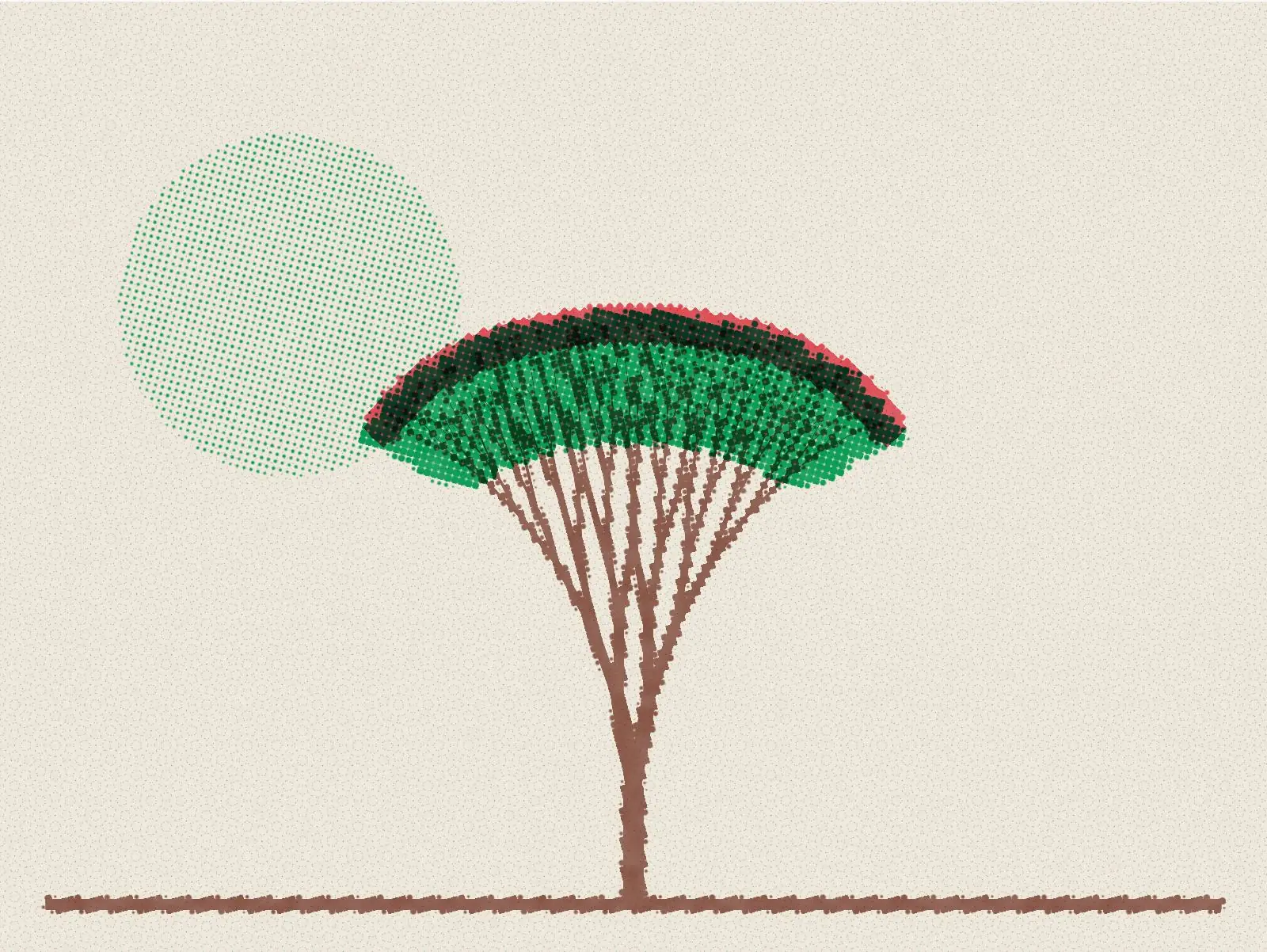
In the 1910s, a Bourbon tree shorter than usual was found on a farm in Minas Gerais, in southeastern Brazil. The spaces between its nodes were shorter, and the whole tree was compact. This dwarf mutant was later named Caturra.
Being short has practical benefits. Harvesting is easier, and more trees can be planted per unit of land, which means more cherries from the same land. Able to raise productivity while keeping the cup quality inherited from Bourbon, this variety spread rapidly through Latin America. Colombia, Costa Rica, Guatemala, Nicaragua: it has long been the mainstay in many origins.
Dwarfism
Dwarfism means shorter gaps between nodes
A tree that demands fertilizer
But Caturra comes with conditions. Planted densely for high yields, it also draws more nutrients from the soil. Skimp on fertilizing and management and the tree quickly wears out. It is not suited to low-input growing; it gives back as much as you put in.
Nor does it have resistance to leaf rust. It inherited Bourbon's weakness unchanged, and has been hit hard during leaf rust epidemics. In the great outbreak that swept Central America around 2012, the farms that relied most on Caturra suffered the worst damage.
Timeline
How one mutant tree changed the density of fields
- 1910s
A short Bourbon is found on a farm in Minas Gerais, Brazil
- Later
Thanks to dense planting and efficient harvesting, it spreads quickly to Colombia and Central America
- Late 1940s–
- Around 2012
In the leaf rust epidemic in Central America, farms relying on Caturra suffer most
Where its taste stands
The cup is bright and clean, with citrus-like acidity coming through easily. It does not have Bourbon's depth of sweetness, but Caturra grown carefully at high altitude easily reaches specialty level. For a long time it served as the reference point for "standard good quality".
Its role as a parent
Caturra's dwarfism proved extremely useful for breeding. Many varieties, starting with Catuai (a cross with Mundo Novo), have Caturra as one parent. The Catimor lines, born from crosses with the rust-resistant Timor Hybrid, also carry Caturra's blood.
The Catimor we carry from Cầu Đất and Sơn La also traces back to this single mutant tree. The highlands of Vietnam and a field in Brazil are connected across a hundred years.
Family tree
The family tree of varieties (generations run top to bottom)
← Scroll sideways →
- Ethiopian landraces → Typica (via Yemen)
- Ethiopian landraces → Bourbon (via Yemen)
- Ethiopian landraces → Geisha
- Typica → Maragogipe
- Typica → Mundo Novo
- Bourbon → Mundo Novo
- Bourbon → Pacas
- Bourbon → Caturra
- Bourbon → Villa Sarchi
- Bourbon → SL28 / SL34
- Canephora → Timor Hybrid
- Maragogipe → Pacamara
- Pacas → Pacamara
- Mundo Novo → Catuai
- Caturra → Catuai
- Caturra → Catimor
- Timor Hybrid → Catimor
- Villa Sarchi → Sarchimor
- Timor Hybrid → Sarchimor
- Sarchimor → Marsellesa
- Sarchimor → Centroamericano
- Wild Ethiopian coffee → Centroamericano
- Marsellesa → Starmaya
- Centroamericano → Starmaya
The variety family tree puts the connections between varieties and their differences in character into a single diagram.